
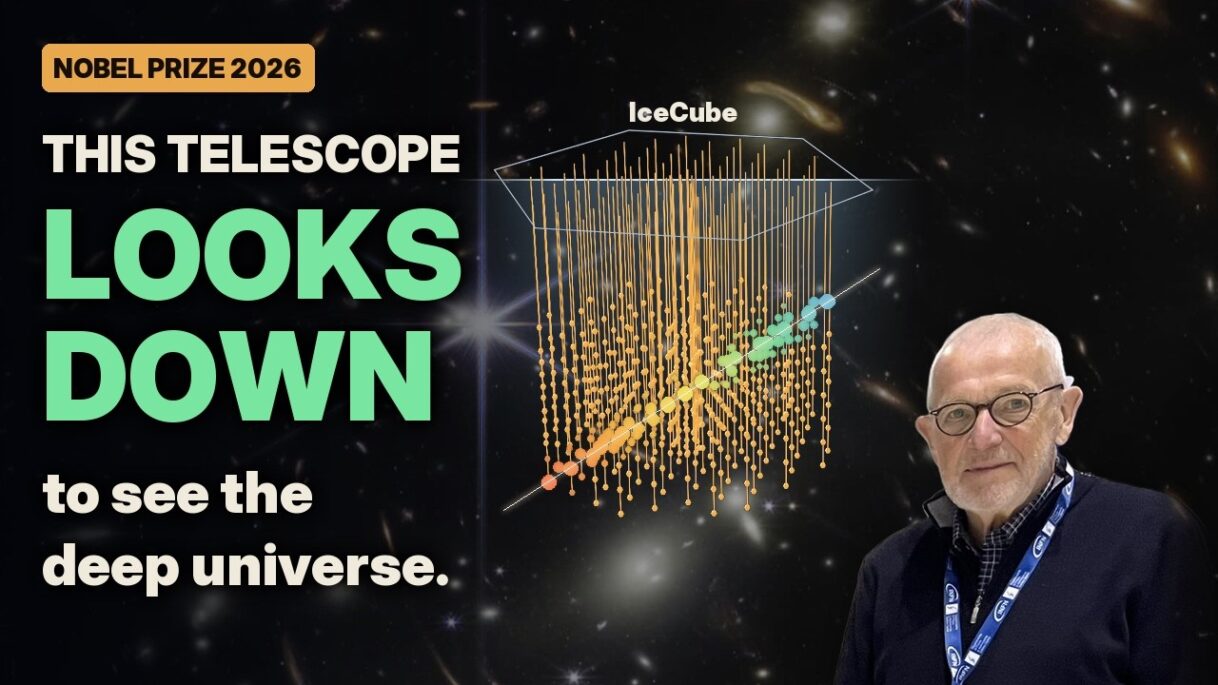
At the South Pole, 5,160 glass sensors sit up to two and a half kilometres beneath the ice, waiting for particles that have crossed billions of light-years. This is the story of IceCube, an idea that almost nobody believed would work, and the discovery that won the 2026 Nobel Prize in Physics.
We follow Francis Halzen’s “unreasonable” idea from Pauli’s ghost particle in 1930, through the near-failure of AMANDA, to the first high-energy cosmic neutrinos in 2013 and the blazar TXS 0506+056 on 22 September 2017. Along the way: why a muon outruns light in ice, and how a detector made of ice reads direction and energy.
CHAPTERS
00:00 5,160 eyes in the dark
01:08 The ghost particle
02:26 An unreasonable idea
03:58 The blind ice
04:51 Going deeper
06:00 Why a cubic kilometre?
06:46 Cosmic accelerators
07:46 How to see the invisible
09:01 Rebuilding a particle from light
09:42 The noise problem
10:37 Bert and Ernie
11:21 22 September 2017
12:44 The Nobel Prize
13:44 Seeing farther by going deeper
KEY SOURCES
– The Nobel Prize in Physics 2026, Royal Swedish Academy of Sciences (press release and scientific background).
– IceCube Collaboration, “Evidence for High-Energy Extraterrestrial Neutrinos at the IceCube Detector”, Science 342 (2013).
– IceCube, Fermi-LAT, MAGIC et al., “Multimessenger observations of a flaring blazar coincident with high-energy neutrino IceCube-170922A”, Science 361 (2018).
– IceCube Collaboration, “Neutrino emission from the direction of the blazar TXS 0506+056 prior to the IceCube-170922A alert”, Science 361 (2018).
– IceCube Collaboration, “Evidence for neutrino emission from the nearby active galaxy NGC 1068”, Science 378 (2022).
– IceCube Collaboration, “Observation of high-energy neutrinos from the Galactic plane”, Science 380 (2023).
NARRATION
AI-generated voice (MiniMax Audio, commercial licence). Script, research and editing by K18 Studio.
MUSIC & SOUND
Music: “Serene View” by Arulo (Mixkit, Mixkit Stock Music Free License).
Sound effects: Sonniss GDC Game Audio Bundle (royalty-free licence) and Mixkit (Mixkit Sound Effects Free License).
FOOTAGE & IMAGES
Simulations and illustrations are labelled on screen. Diagrams are original (K18 Studio). Third-party material keeps its original licence; changes made: cropped, resized, colour-graded, audio removed.
Public domain (U.S. Government):
– NASA Goddard Space Flight Center (SVS 12994, IceCube & Fermi animation; Conceptual Image Lab blazar animations; SVS 4060 Bedmap2; SVS 13094 cosmic-ray air shower; SVS 14620 and 14619 black hole visualizations (NASA/JPL-Caltech/R. Hurt, IPAC); SVS 13197 merging black holes (Bernard J. Kelly); SVS 31348 Cosmic Cliffs 3D (STScI, Caltech/IPAC, NASA’s Universe of Learning); Fermi animations; IceBridge Greenland; aurora australis from space; SDO Sun; flight over Antarctic sea ice)
– NASA/DOE/Fermi LAT Collaboration (TXS 0506+056 gamma-ray maps)
– NOAA Ocean Exploration (deep-sea footage; Okeanos Explorer, Pearl Harbor)
– U.S. Department of Defense / DVIDS (Operation Deep Freeze, Sgt. Dahnyce Baucom)
– Bill Spindler, U.S. Antarctic Program / NSF (Amundsen–Scott South Pole Station, 2007)
– Los Alamos National Laboratory / U.S. DOE (Reines and Cowan, 1956)
– Benjamin Couprie (Solvay Conference, 1927)
CC0:
– INFN / XXI International Workshop on Neutrino Telescopes 2025 (photos of Francis Halzen)
CC BY:
– John Hardin (Mirriat), “The ICL at Night” and “The ICL at Dawn” — CC BY 4.0
– Christopher Michel, Amundsen–Scott South Pole Station — CC BY 2.0
– Richard Hurd, Bascom Hall, UW–Madison — CC BY 2.0
– CSIRO Atmospheric Research, air bubbles trapped in ice — CC BY 3.0
– Egmason, DUMAND schematic — CC BY 3.0
– Stephen Curry, cloud chamber — CC BY 3.0
– Swedrone, Stockholm aerial — CC BY 3.0
– CLUES project, cosmic web simulation — CC BY 4.0
– ESO, NGC 1068 / Messier 77 — CC BY 4.0
– NASA, ESA, CSA, STScI (ESA/Webb): Webb’s First Deep Field, Stephan’s Quintet, Tarantula Nebula; ESA/Webb, A. Adamo & FEAST team: Phantom Galaxy — CC BY 4.0
– NOIRLab/LIGO/NSF/AURA/T. Matsopoulos, LIGO Hanford interior — CC BY 4.0
CC BY-SA:
– Christopher Michel, IceCube Neutrino Observatory 2023 — CC BY-SA 4.0
– Bettina Katzenstein / ETH-Bibliothek Zürich, Wolfgang Pauli 1946 — CC BY-SA 4.0
– Christopher Wiebusch, AMANDA detector schematic — CC BY-SA 4.0
– Mike Peel, MAGIC telescopes, La Palma — CC BY-SA 4.0
– I99pema, Royal Swedish Academy of Sciences — CC BY-SA 4.0
– Giles Laurent, person under the Milky Way — CC BY-SA 4.0
– Amble, IceCube drill camp 2009 and South Pole skiers — CC BY-SA 3.0
– Taavi Adamberg, IceCube DOM — CC BY-SA 3.0
– Levent Demirörs, South Pole dome — CC BY-SA 2.0
Licence texts: creativecommons.org/licenses
Independent explainer, not affiliated with or endorsed by the IceCube Collaboration, NASA, the Nobel Foundation or any institution shown.
#IceCube #NobelPrize #Neutrino #Physics #Antarctica
source

