
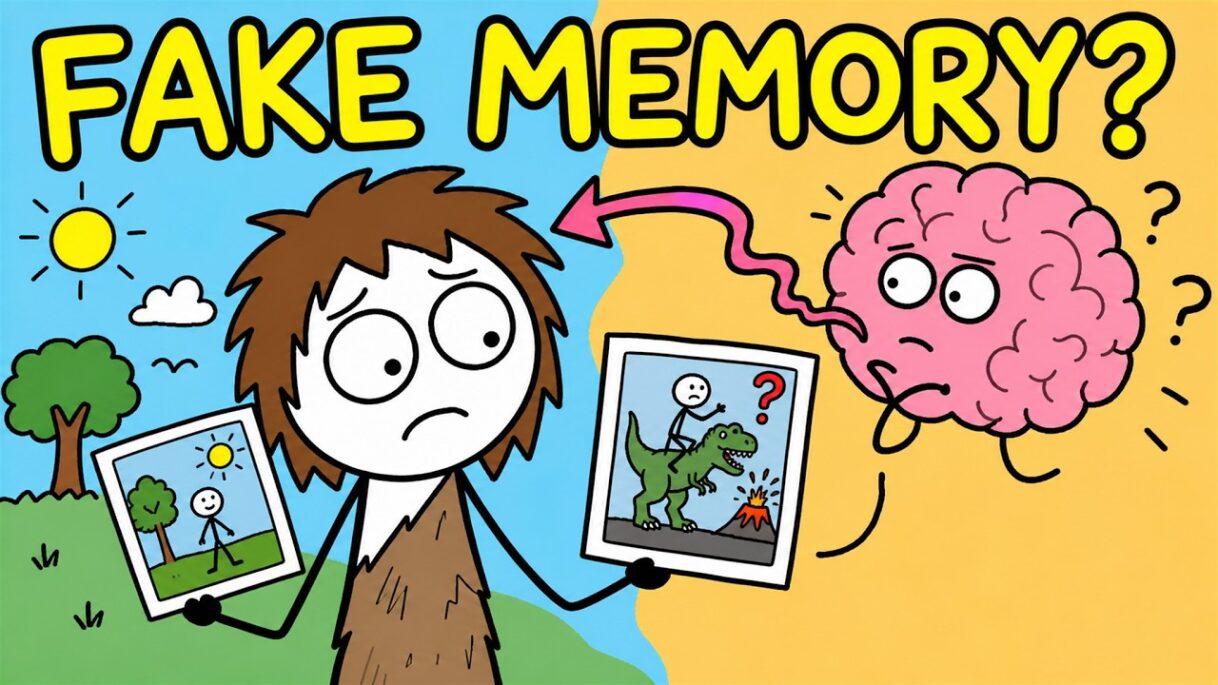
Have you ever remembered something so clearly that it felt impossible to be wrong? 🧠
Maybe it was a logo. A childhood moment. A conversation. A detail in a photo.
And then one day, you find out it never happened that way.
That feeling is unsettling because memory feels like proof. But your brain may not be replaying the past. It may be rebuilding it.
This video walks through why false memories happen, how suggestion can change what people remember, why confidence does not always mean accuracy, and how AI-generated images could make human memory even easier to confuse. 👀
What this video covers:
– Why memory is reconstruction, not playback
– How your brain fills in missing details
– How one word can change what people remember
– Why false childhood memories can form
– Why confidence and accuracy are not the same thing
– How memory and imagination may share the same machinery
– Why creativity and false memory may both rely on association
– How AI-generated images and videos could reshape what people think they saw
This is not about distrusting every memory you have.
It is about understanding what memory really does: it uses yesterday to help you survive tomorrow.
Thanks for watching and supporting the channel. If this made you question one of your own memories, tell me which one in the comments. 🙏
Nuro
Educational note: This video is for general education and storytelling. It is not legal, medical, or psychological advice, and it should not be used to judge any specific real-world memory, witness account, diagnosis, or investigation.
━━━━━━━━━━━━━━━━━━━━
SOURCES
FALSE MEMORIES
UChicago News. “False Memories, explained.” UChicago News – The University of Chicago, 2025. https://news.uchicago.edu/explainer/false-memories-explained
Supports the broad explanation of false memories and why sincere recall can still be inaccurate.
CONSTRUCTIVE MEMORY
The Decision Lab. “Constructive Memory.” The Decision Lab, 2026. https://thedecisionlab.com/reference-guide/psychology/constructive-memory
Supports the idea that memory is reconstructed from fragments rather than replayed like a recording.
ADAPTIVE MEMORY
Schacter, Daniel L. “Adaptive constructive processes and the future of memory.” American Psychologist, 2012. https://doi.org/10.1037/a0029869
Supports the connection between flexible memory, future simulation, and the usefulness of constructive remembering.
MISINFORMATION EFFECT
Wikipedia. “Misinformation effect.” Wikipedia, 2026. https://en.wikipedia.org/wiki/Misinformation_effect
Supports the overview of how post-event information can affect later recall.
MISINFORMATION EFFECT
The Decision Lab. “The Misinformation Effect.” The Decision Lab, 2026. https://thedecisionlab.com/reference-guide/psychology/the-misinformation-effect
Supports the plain-language explanation of misleading information changing memory.
LOST IN THE MALL
Wikipedia. “Lost in the mall technique.” Wikipedia, 2026. https://en.wikipedia.org/wiki/Lost_in_the_mall_technique
Supports the section on how suggestion can contribute to partial false childhood memories.
MEMORY AND CREATIVITY
Harvard Magazine. “Harvard Professor Daniel Schacter on How Memory is Related to Creativity.” YouTube, 2025. https://www.youtube.com/watch?v=tyPDnyOwp4k
Supports the discussion of memory, imagination, and creative recombination.
MEMORY AND CREATIVITY
Harvard Magazine. “Is Memory Connected to Creativity?” Harvard Magazine, 2025. https://www.harvardmagazine.com/2025/01/harvard-study-memory-creative-thinking
Supports the link between memory processes and creative thinking.
AI AND FALSE MEMORIES
MIT Media Lab. “Overview – AI-Implanted False Memories.” MIT Media Lab, 2025. https://www.media.mit.edu/projects/ai-false-memories/overview/
Supports the section on AI-generated or AI-edited media influencing recollection.
AI AND HUMAN MEMORY
Anadolu Ajansi. “Billions of fake images, videos generated by AI rewrite human memory.” Anadolu Ajansi, 2026. https://www.aa.com.tr/en/world/billions-of-fake-images-videos-generated-by-ai-rewrite-human-memory/3831709
Supports the broader concern that synthetic media can shape what people believe they saw.
DEEPFAKES AND COGNITION
Facia.ai. “Why AI Deepfakes Are Changing Human Cognition and Emotional Perception.” Facia.ai, 2026. https://facia.ai/blog/why-ai-deepfakes-are-changing-human-cognition-and-emotional-perception/
Supports the discussion of deepfakes, perception, and emotional response.
━━━━━━━━━━━━━━━━━━━━
#memory #psychology #falsememory #brain #science #ai #deepfakes
source

