
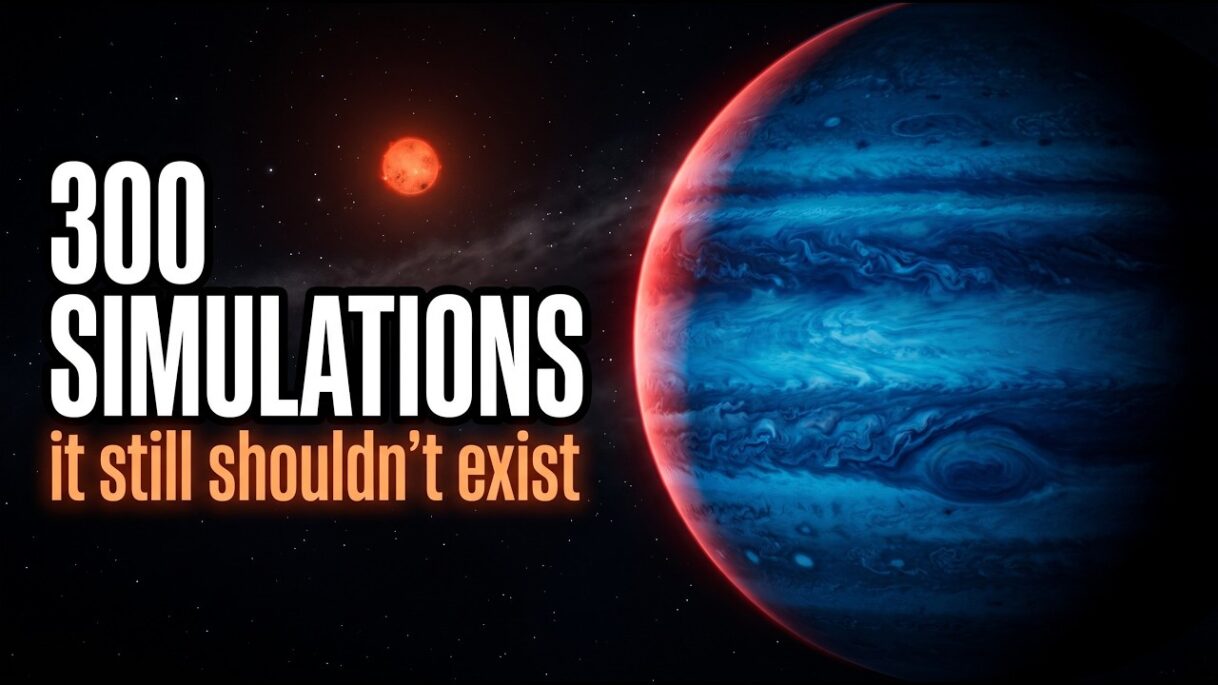
Fifty-one light years from Earth sits a planet that our best theories say cannot exist. When astronomers found it, they ran their planet formation models three hundred times trying to reproduce it. Three hundred simulations. Three hundred failures. The planet was still there.
This is the story of LHS 3154 b — a Neptune-class world orbiting an ultracool dwarf star barely massive enough to count as a star at all, completing a full year every 3.7 days. Discovered with the Habitable Zone Planet Finder at McDonald Observatory and confirmed independently by NASA’s TESS, it is the most massive planet ever found in a close orbit around a star this small.
Both of our leading theories of planet formation — core accretion and gravitational instability — walked up to this world and walked away defeated. And because stars like LHS 3154 are the most common stars in the Milky Way, one impossible planet may mean our entire census of the galaxy’s worlds is built on a cracked foundation.
🔔 Subscribe for more journeys to the edge of what we understand.
⏱️ Timestamps below 👇
0:00 The Planet That Broke Science
1:05 The Rulebook: How Planets Are Born
1:47 The Iron Rule — Small Star, Small Planets
2:14 Meet LHS 3154: Barely a Star at All
3:01 The Instrument Built to Hunt Them
3:40 A Wobble Every 3.7 Days
3:58 Ruling Out a False Alarm
4:33 13 Earth Masses — The Trouble Begins
5:42 300 Simulations, 300 Failures
6:15 Cheating the Model
6:43 The Rival Theory Fails Too
7:22 What This World Is Actually Like
8:13 TRAPPIST-1: The System That Followed the Rules
9:09 It’s Not Alone — The Other Rule Breakers
10:02 Why “Closer Than You Think” Matters
10:48 The Silent Majority of the Galaxy
11:37 Why This Is Science Working Correctly
12:46 What’s Next: The Impossible Black Hole
#Exoplanet #Astronomy #SpaceDocumentary #Astrophysics #NASA
source

