
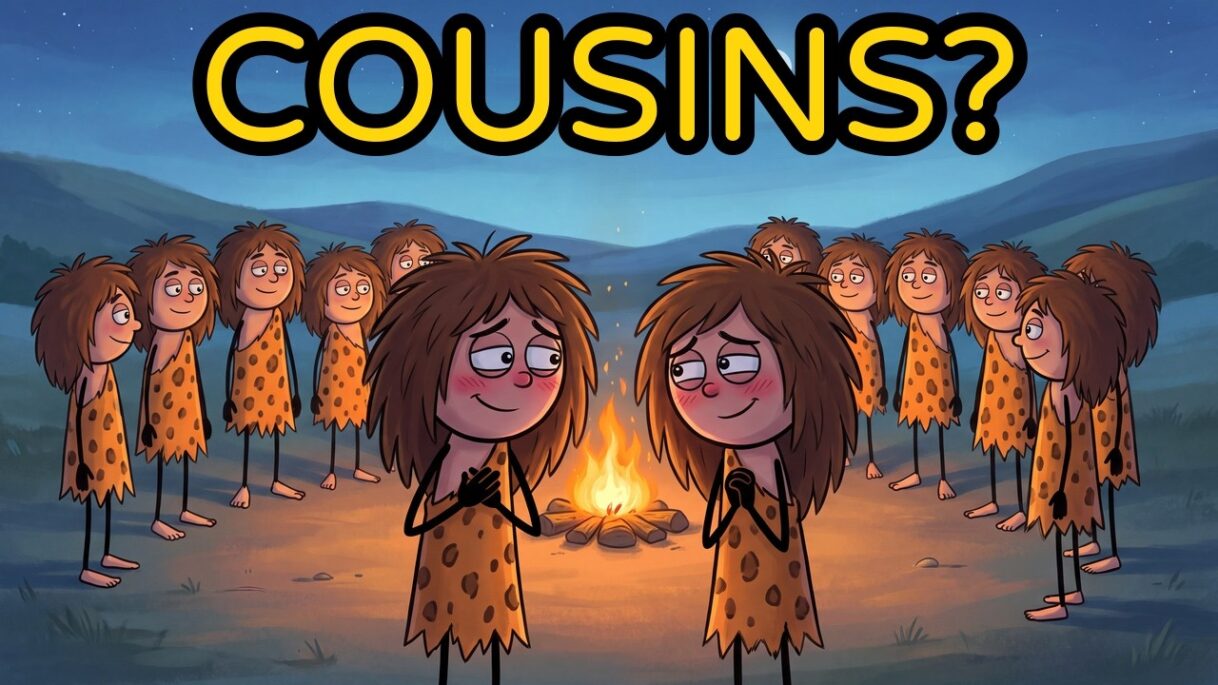
They lived among twenty-five faces and still fell in love. How ancient humans found each other — and why the search, not the feeling, is the new part.
How did ancient humans find love? Prehistoric courtship, hunter-gatherer marriage, and the oldest love poem on Earth.
A band was about twenty-five people, and almost everyone in it was family. So every generation had to find someone outside — at the seasonal gatherings where bands met, wearing beads carried hundreds of kilometres to be seen in. The genetic record says those networks were real, and older than our species. The written record says the feeling is at least as old as writing itself.
What’s in the video:
• Why a band of 25 forced people to marry out — and the 1970s simulation that put a number on it
• The 34,000-year-old burial in Russia whose genomes proved the mating network existed
• A Neanderthal group in Spain where the women had all come from somewhere else
• Sea-snail beads over 100,000 years old — the oldest jewellery, worn for strangers’ eyes
• Why most first marriages were arranged, and how recently marrying for love became normal
• Romantic love documented in 147 of 166 cultures — and what lit up in the brain scanner
• The oldest love poem (4,000 years) and the oldest recorded kiss (4,500 years)
• The 1–2% of your DNA that records seven thousand years of choosing across a species line
• The double grave outside Mantua that archaeologists refused to separate
Sources:
– Wobst, “Boundary Conditions for Paleolithic Social Systems”, American Antiquity (1974) — minimum mating-network simulation
– Sikora et al., Science (2017) — Sunghir genomes, mate-exchange networks
– Lalueza-Fox et al., PNAS (2011) — El Sidrón Neanderthal group; patrilocality reading (contested — see Vigilant & Langergraber reply, same journal)
– Vanhaeren et al., Science (2006); Bouzouggar et al., PNAS (2007) — Nassarius shell beads, Skhul / Oued Djebbana / Taforalt
– Walker, Hill, Flinn & Ellsworth, PLoS ONE (2011) — evolutionary history of hunter-gatherer marriage practices
– Coontz, “Marriage, a History” (2005) — marrying for love as a late-18th-century norm
– Jankowiak & Fischer, Ethnology (1992) — romantic love in 147 of 166 cultures
– Aron, Fisher, Mashek, Strong, Li & Brown, Journal of Neurophysiology (2005) — fMRI of early-stage romantic love
– Istanbul #2461, trans. Samuel Noah Kramer (1951) — the love song of Shu-Sin, Istanbul Museum of the Ancient Orient
– Arbøll & Rasmussen, Science (2023) — earliest documented kissing, Mesopotamia
– Menotti et al., excavation reports (2007); Archaeology Magazine (2008) — the Lovers of Valdaro
– Iasi et al., Science (2024); Sümer et al., Nature (2024) — dating the Neanderthal admixture pulse
Where the science is still open: the El Sidrón “women moved between groups” reading is argued over; the earliest arranged-marriage reconstruction is equivocal; a genome records mating, not feeling; and nobody knows who the two people in the Valdaro grave were to each other. Where the video says “roughly” or “the team behind it thinks”, that’s why.
source

