
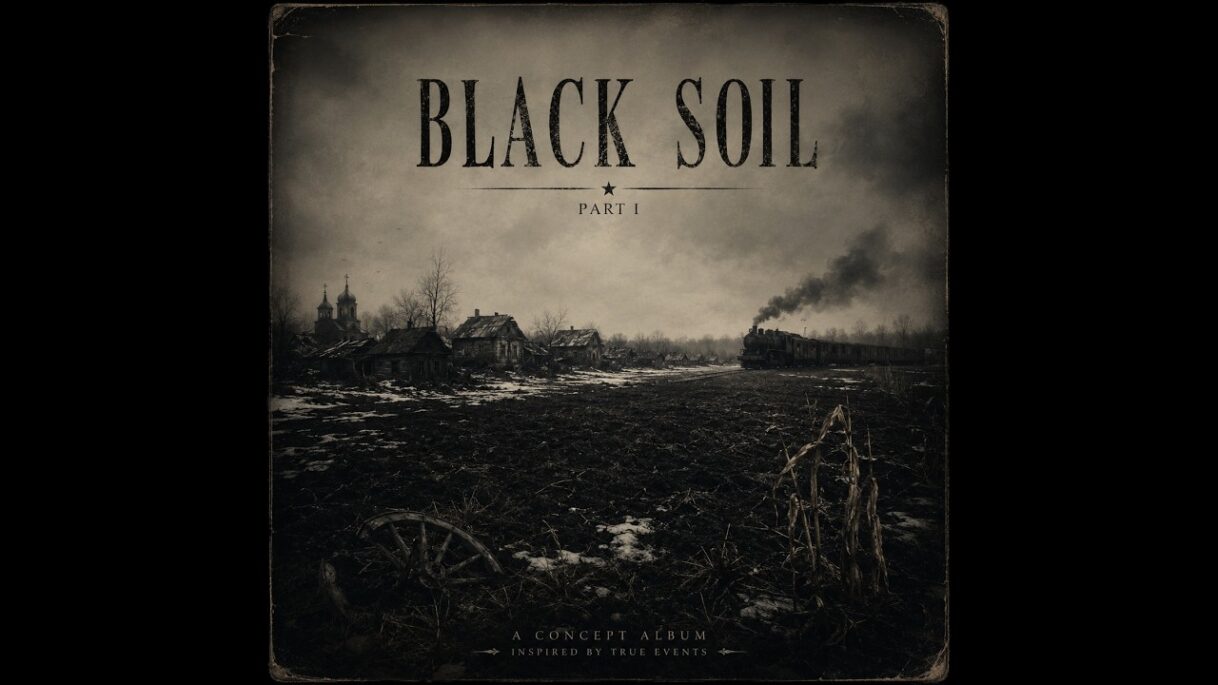
BLACK SOIL — PART I & II
A two-part musical story inspired by the Holodomor and the lives caught inside one of the darkest chapters of the 20th century.
This is not a documentary.
It is a story told through music — inspired by documented historical events, but seen through the eyes of fictional ordinary people who might have lived through them.
The story begins far from death.
It begins with black soil.
With endless fields of wheat, small villages, families around kitchen tables and people who believed that tomorrow would look much like today.
Ukraine was one of Europe’s great agricultural regions — a land famous for its extraordinarily fertile soil and vast harvests.
Then the world around these families begins to change.
Officials arrive from the cities.
The grain is counted.
Quotas are imposed.
Names are written into ledgers.
Food disappears from homes.
Villages that fail to meet demands can be blacklisted and isolated.
Even taking grain from the fields can become a crime.
And while people grow hungry beside the land that once fed them, trains continue to carry grain away.
BLACK SOIL — PART I follows that descent.
Not through politicians or speeches, but through a family, a village and the small things that disappear one by one:
Bread.
Dogs barking after dark.
Smoke from neighboring chimneys.
Children playing outside.
Voices.
Hope.
Eventually, only the black soil remains.
But the story does not end when the hunger ends.
PART II — ECHOES OF BLACK SOIL: THE SILENCE REMAINED begins with the survivors.
The snow melts.
The fields return.
People rebuild houses and reopen schools.
From the outside, life continues.
Inside the homes, something has changed forever.
People learn which questions should never be asked.
Parents lower their voices around their children.
Names disappear from conversations.
Books tell a different history from the one people remember.
Some who disappeared eventually return — carrying experiences they cannot safely describe.
Fear no longer needs to knock on the door.
It has become part of everyday life.
Part I is about the destruction of the body through hunger.
Part II is about what happens afterward — when fear, silence and memory are passed from one generation to another.
There are no historical protagonists in these songs.
The families and individuals you hear are fictional.
But the world surrounding them is inspired by real history: collectivization, grain requisitions, blacklisting, the Soviet security apparatus, restrictions on movement, the so-called “Law of Five Ears of Grain,” mass hunger, repression and the silence that followed.
The music deliberately changes with the story.
The first songs contain warmth, acoustic instruments and the sounds of an Eastern European countryside still full of life.
As the story progresses, the arrangements become colder, thinner and quieter.
By the second album, silence itself has become part of the music.
Because this story was never meant to turn suffering into entertainment.
It was made for another reason:
To remember the ordinary people who disappeared between the lines of history.
The earth survived.
The wheat returned.
And eventually, so did the truth.
Some histories should never be allowed to disappear into silence.
source

