
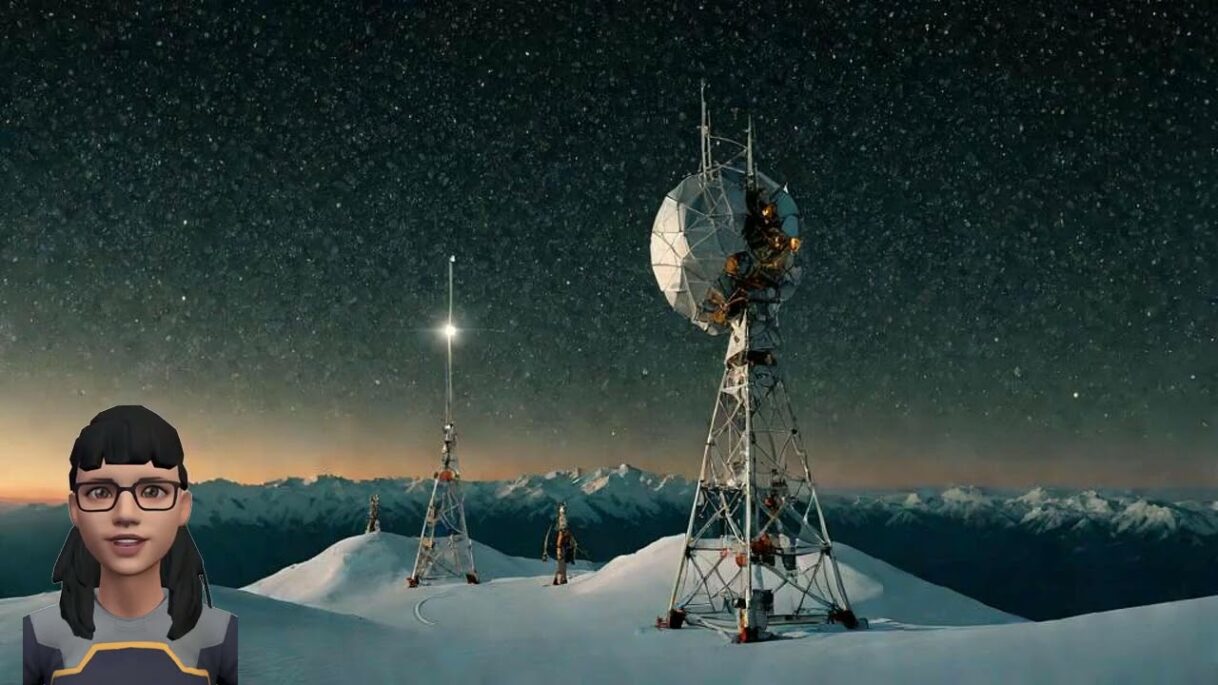
Radio astronomy opened the universe at wavelengths from sub-millimetre to tens of metres, revealing phenomena invisible to optical telescopes: synchrotron jets, the cold neutral hydrogen of galaxies, cosmic masers, the cosmic microwave background, pulsars, and the silhouettes of supermassive black holes. Because angular resolution scales as θ ≈ λ/D and radio wavelengths are roughly a million times longer than visible light, a single dish cannot resolve fine detail; the field’s defining innovation is interferometry, in which separated antennas are combined so that the resolving power is set by the baseline separation rather than any one aperture. This chapter traces the discipline from Jansky’s 1932 detection of Galactic radio noise through Ryle’s Nobel-winning aperture synthesis to the modern flagship arrays. It develops the physical and mathematical core — the two-element interferometer, the complex visibility, the van Cittert–Zernike theorem, the (u,v) plane, and the CLEAN and self-calibration algorithms that turn sparsely sampled Fourier data into images. It then surveys the instruments that realise these ideas: the Karl G. Jansky Very Large Array, the Atacama Large Millimeter/submillimeter Array (ALMA), Very Long Baseline Interferometry (VLBI) and its geodetic and astrometric uses, and the Event Horizon Telescope’s Earth-spanning array that imaged M87* and Sgr A*. It closes with the next generation — the Square Kilometre Array and the ngVLA — distinguishing settled engineering from frontier and speculative work.
———
From *The Series* by University of Luke — Space & Astronomy · Vol 3 — Observational Astronomy & Instruments · Chapter 3.
Each chapter is a book rendered as immersive video: narrated by Isabella, a stylized 3D presenter, over rights-clean, on-box-generated imagery. 100% locally produced — original narration and visuals, offered as an educational reference.
Sources & further reading:
• Karl Jansky | Biography, Discovery, & Facts https://www.britannica.com/biography/Karl-Jansky
• Grote Reber, Radio Astronomer https://www.nist.gov/blogs/taking-measure/grote-reber-radio-astronomer
• The Hydrogen 21-cm Line and Its Applications to Radio Astrophysics https://web.mit.edu/lululiu/Public/8.14/21cm/21cm.pdf
• Radio & Optical Interferometry: Basic Observing Techniques and Data Analysis (arXiv:1201.2963) https://arxiv.org/pdf/1201.2963
• The Van Cittert–Zernike Theorem https://www.gmrt.ncra.tifr.res.in/doc/WEBLF/LFRA/node19.html
• The Fourier Approximation & the van Cittert–Zernike Theorem http://math_research.uct.ac.za/~siphelo/admin/interferometry/4_Visibility_Space/4_5_The_Fourier_Approximation_VanCittert-Zernike_Theorem.html
#UniversityOfLuke #Astronomy #education
source

