
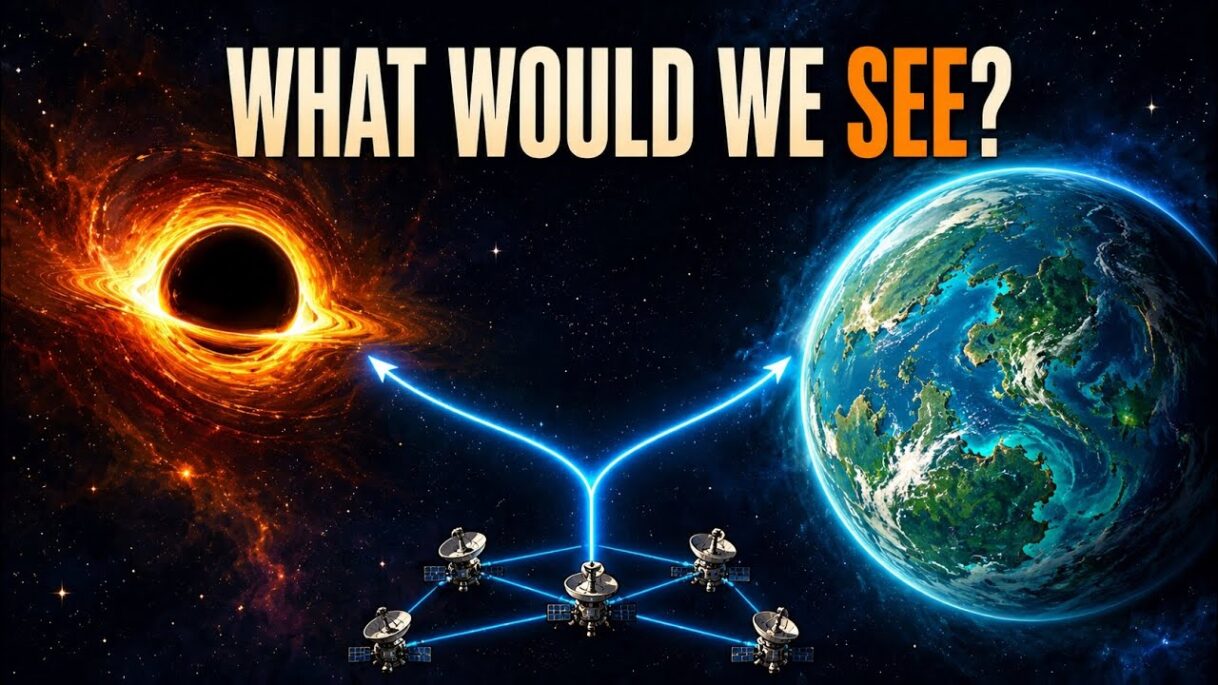
What if the largest telescope ever created wasn’t a single object—but the entire Earth? 🌍🔭
In 2019, the Event Horizon Telescope revealed the first image of a black hole: M87*, a cosmic giant located about 55 million light-years away.
But nobody built a planet-sized mirror.
Instead, astronomers synchronized radio observatories across the world with atomic clocks, collected enormous amounts of data and combined their observations to make Earth behave like one enormous virtual telescope.
In this video, we explore:
🔭 How the Event Horizon Telescope actually works
🌍 Why the distance between observatories matters
💾 Why its data had to be transported on physical hard drives
🕳️ How astronomers reconstructed the image of M87*
🛰️ How the Black Hole Explorer could extend this telescope into space
☀️ How the Sun’s gravity could act as a natural cosmic lens
🪐 Whether a telescope could someday span the entire Solar System
🌌 What such an instrument might reveal about black holes—or distant worlds that could be alive
Some of these ideas already exist. Others remain extraordinarily ambitious mission concepts. Together, they show how an astronomical instrument can become larger than the world that created it.
If we could use the entire Solar System as a telescope, where would you point it?
Toward the edge of a black hole—or toward a distant world that might be alive? Let me know in the comments. 👇
🚀 Subscribe to Earth Facts for more cinematic journeys through Earth, space, physics and the future of humanity.
Explore the universe, one fact at a time.
⏱️ CHAPTERS
00:00 The Telescope Nobody Built
00:39 Why Earth Had to Become the Telescope
01:31 How Separate Dishes Become One Telescope
02:47 The Hardest Group Photo
03:57 What the First Image Really Shows
05:15 Beyond the Earth-Sized Telescope
06:35 A Telescope Across the Solar System
08:37 The Sun as a Lens
10:29 The Next Eye
━━━━━━━━━━━━━━━━━━━━
🌍 FOLLOW EARTH FACTS
📸 Instagram: https://www.instagram.com/earth.facts.daily/
🎵 TikTok: https://www.tiktok.com/@earth.factsdaily
📘 Facebook: https://www.facebook.com/profile.php?id=61591188305067
━━━━━━━━━━━━━━━━━━━━
🔬 LEARN MORE
Event Horizon Telescope — First image of M87*:
https://eventhorizontelescope.org/press-release-april-10-2019-astronomers-capture-first-image-black-hole
How very-long-baseline interferometry works:
https://www.eso.org/public/teles-instr/technology/interferometry/
The Black Hole Explorer mission concept:
https://www.blackholeexplorer.org/
NASA — Solar Gravitational Lens mission concept:
Direct Multipixel Imaging and Spectroscopy of an Exoplanet with a Solar Gravity Lens Mission
The proposed future instruments and missions discussed in this video are presented as scientific concepts, not as currently operational or approved missions. Some visuals are artistic representations created to explain complex scientific ideas.
#EarthFacts #Space #Astronomy
source

