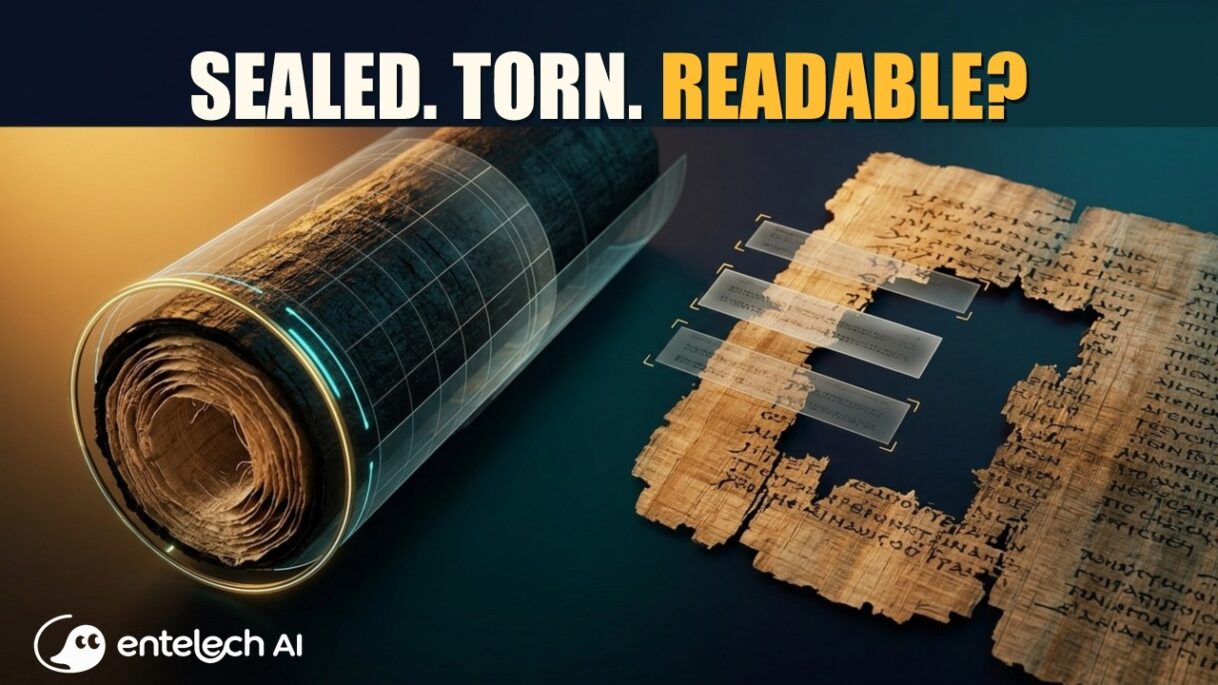
A burned scroll that cannot safely be opened. A Greek text with words missing. Two different problems, and the people using AI to investigate them.
We follow the Vesuvius Challenge and ApolloRestore, with the conservators, imaging specialists, developers and scholars behind the research. Detecting physical ink and suggesting lost wording are different kinds of work. Proposed restorations still require scholarly evaluation.
Like and subscribe to Entelech AI for more stories about people using AI for useful work.
CHAPTERS
0:00 The first word
0:32 Herculaneum
2:08 The surviving scroll
2:43 Protecting the fragile object
3:12 Scan, trace and flatten
4:11 Finding the ink
5:06 Modern test scrolls
5:42 Papyrologists read the evidence
6:16 ApolloRestore
7:22 Ranked restoration candidates
7:50 A birth declaration
8:26 What the test score means
9:30 Everyday lives in papyri
10:04 The next tools
11:54 A second chance
The Apollo paper’s real Figures1 and5 are shown with source credit. In Figure5, surviving ink is black and proposed restorations are red, overlaid by a papyrologist. Other contextual manuscript photographs are not presented as that birth declaration or the newly read scroll. No Vesuvius Challenge NC imagery or1944 eruption footage is used in this revision.
PRIMARY SOURCES
Vesuvius Challenge and first continuous surviving-scroll reading:
https://scrollprize.org/firstscroll
https://arxiv.org/abs/2606.29085
https://scrollprize.org/firstletters
https://scrollprize.org/grandprize
https://scrollprize.org/tutorial5
Casey Handmer’s account:
ApolloRestore:
https://arxiv.org/html/2609.22455v4
https://www.oeaw.ac.at/projects/decoding-antiquity/apollo-ai
Modern test-scroll experiment and documentary history:
https://news.berkeley.edu/2026/09/16/to-read-2000-year-old-burned-scrolls-scientists-burn-their-own/
VISUAL CREDITS
ApolloRestore Figures1 and5: Hope McGovern, Anna Dolganov, Samuel Belkadi, Guillaume Kunsch, Dimitris Vlitas and David A. Smith,2026. Cropped/scaled and placed with explanatory labels. CC BY4.0:
https://arxiv.org/html/2609.22455v4
https://creativecommons.org/licenses/by/4.0/
Yale Beinecke Library: Lauren Manning, cropped/animated, CC BY2.0:
https://commons.wikimedia.org/wiki/File:Yale_University%27s_Beinecke_Rare_Book_and_Manuscript_Library.jpg
https://creativecommons.org/licenses/by/2.0/
Herculaneum overview: Dudva, CC0. Street and Vesuvius crater: Jebulon, CC0. Greek inscription: Furius, CC0. Met Homer and Egyptian fragment photographs: CC0; the Egyptian fragments illustrate material damage, not Greek model input. Plato Phaedrus papyrus and Castrucci1858 Herculaneum print: public-domain reproductions. Physical unrolling apparatus: The Repository of Arts,1809, public domain. Code photograph: Markus Spiske, Pexels License, contextual software work, not actual project code.
Muted study/research footage: cottonbro studio, Tima Miroshnichenko, Adailton Batista and Mikhail Nilov, Pexels License. Cropped excerpts, not depictions of the named researchers.
https://www.pexels.com/license/
Selectable subtitles: English, Arabic, Simplified Chinese, Hindi and US Spanish.
source

