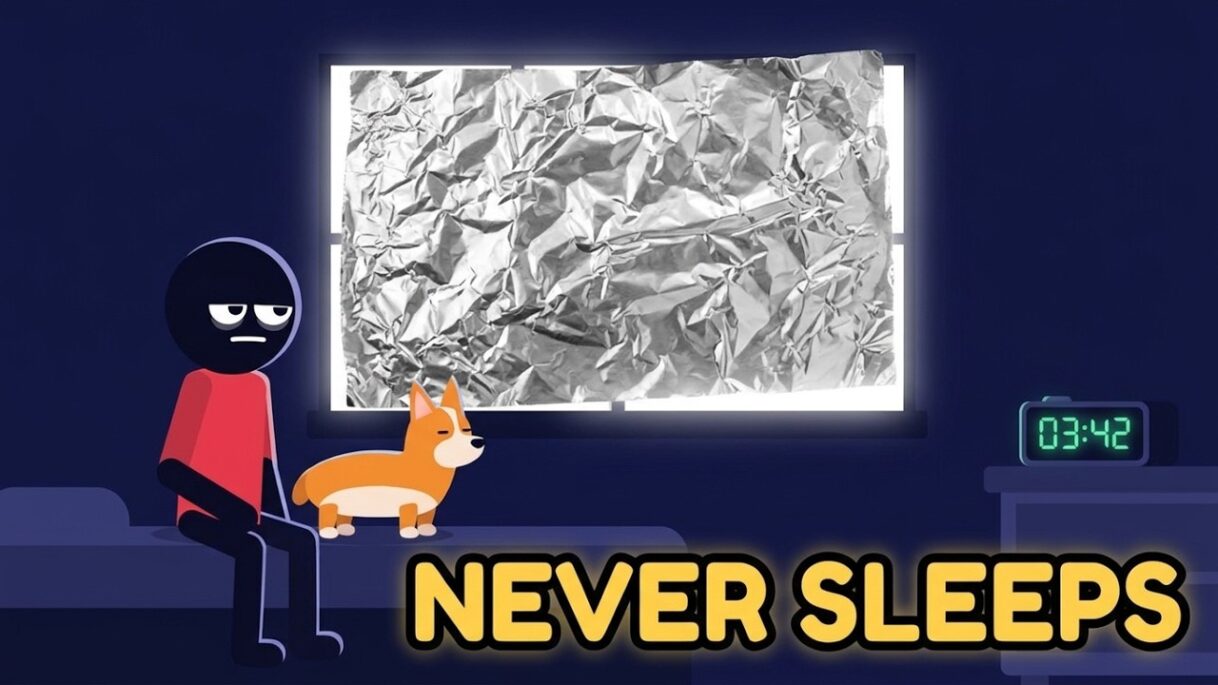
Wednesday, 2:00 a.m. The Sun went down eight hours ago, and outside your window it’s still bright enough to read. Since Monday, the sky won’t turn off. Your mom hasn’t really slept in two days, and Biscuit follows her from room to room all night.
A What If story built on real science: the clock in your brain that runs 24 hours and 11 minutes, the hormone that tells your body “it’s dark now” (and how a simple living-room lamp shuts it up), why night shift work worries cancer researchers, the flower that counts the hours of dark, the biggest migration on the planet that only happens at night, the birds that learn north from the stars, and how people in Tromsø sleep through two months of midnight sun. Told with your mom, Sam, Hervé and his boat the Marie-Lou, and Biscuit the corgi, on a quest for the last truly dark place in town.
Nothing in physics could keep the sky white all night: this is a thought experiment. The studies are real: Czeisler et al. 1999 (Harvard), Gooley et al. 2011, IARC 2019, Knop et al. 2017, Hamner & Bonner 1938, Blachowiak-Samolyk et al. 2006, Emlen 1970, Falchi et al. 2016 and Kyba et al. 2023. And the fading night sky isn’t imaginary at all.
On the first night without darkness, would you go outside, or build the darkest room in town? Write “outside” or “dark” in the comments.
0:00 It’s 2 a.m.
0:36 The rule
1:05 The party
1:33 The clock in your brain
2:00 The hormone
3:06 The curtains
3:44 The night shift
4:09 The garden
4:40 The flower that counts the dark
5:13 The sea
5:56 The birds and the stars
6:14 The part that isn’t imaginary
6:45 The hold
7:49 The trick
8:26 One year later
9:15 Outside or dark?
source

